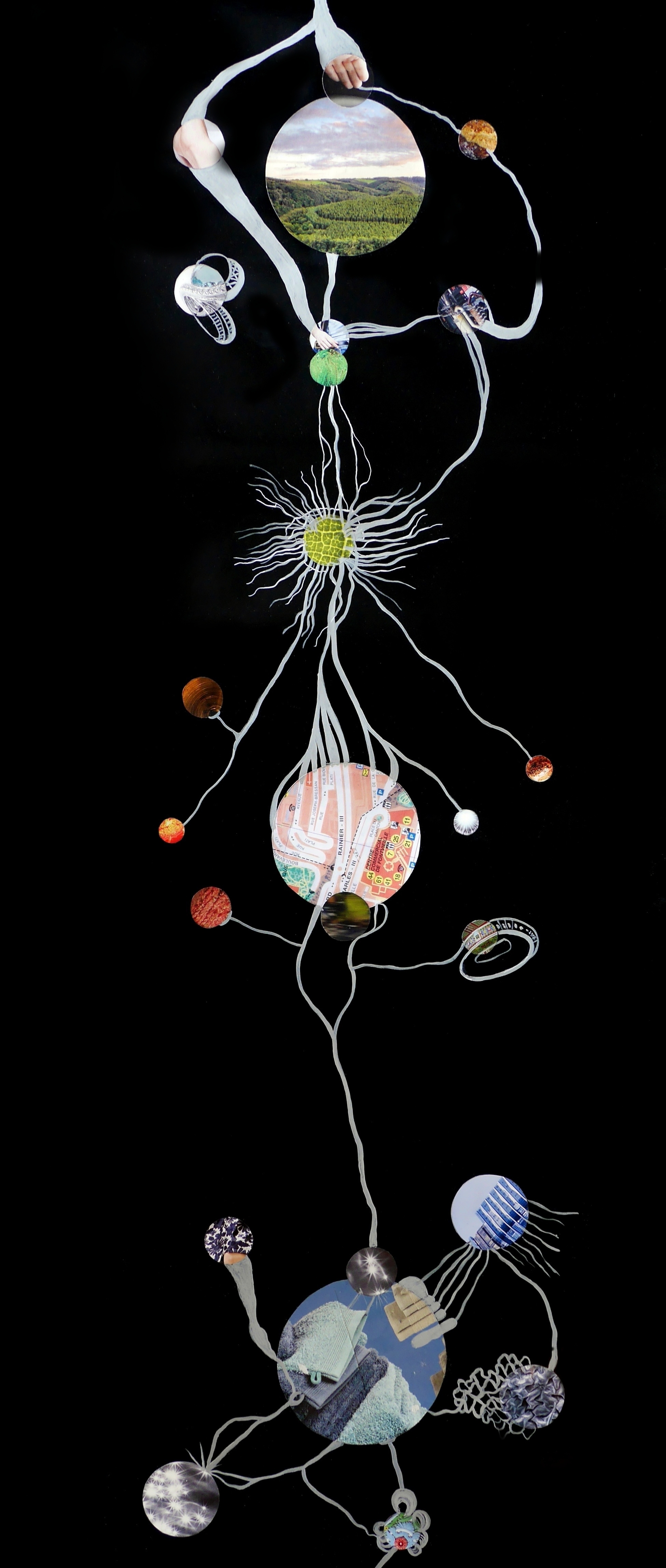
Unrolling the Human Body initially appears as a constellation of planets floating against a dark background. The circular forms, their different sizes and their delicate connections create a distinctly cosmic impression. Yet as the eye moves closer, this first reading begins to dissolve.
Inside the circular forms are fragments of the world around us: landscapes, objects from everyday life, parts of city maps, elements of fabric, images of meat, houses and contemporary skyscrapers. Removed from their original context and enclosed within circular forms, these fragments begin to resemble distant celestial bodies.
The circular shape therefore creates an illusion of scale. What first appears to be a planet may contain a fragment of a city, an ordinary object or a piece of everyday reality. The familiar becomes unfamiliar through a change of scale and context, allowing the same image to move between the terrestrial and the cosmic.
The different bodies are connected by delicate painted lines and branching patterns. These connections are subtle, but they prevent the forms from becoming isolated objects. Instead, they suggest a larger living system in which different fragments of human experience are related to one another.
At the top of the composition, a human hand enters the network directly. Throughout the larger paper roll, human figures are woven into the channels that connect the different bodies. The human presence is therefore not separate from the system, but embedded within it.
The channels can be read simultaneously as bodily pathways, organic networks and connections between planetary bodies. The human body is not represented as a literal anatomical structure. It becomes a metaphorical system of interconnected worlds, while the surrounding universe can simultaneously be understood through fragments of human life.
The collage elements come from the visible world and from contemporary visual culture. They function as fragments of reality, brought into new relationships and transformed into parts of another visual system. A city, a landscape, an everyday object or a human figure can become one element within a larger body.
The work continues the artist's exploration of micro and macro scales, where perception shifts between what something appears to be and what it contains. A planetary body may become a fragment of a city; a cosmic form may contain an ordinary object; and a collection of apparently unrelated fragments may form a single interconnected body.
Unrolling the Human Body is part of a larger project in which human, organic, terrestrial and cosmic forms are brought into the same continuous system. The body becomes a universe, and the universe becomes something that can be read through the fragments of human life.